



Consumer goods companies manage complex relationships across retailers, distributors, wholesalers, ecommerce channels, field sales teams and end customers.
Without the right CRM system, customer data becomes fragmented, reporting becomes manual and commercial teams struggle to gain a clear view of performance.
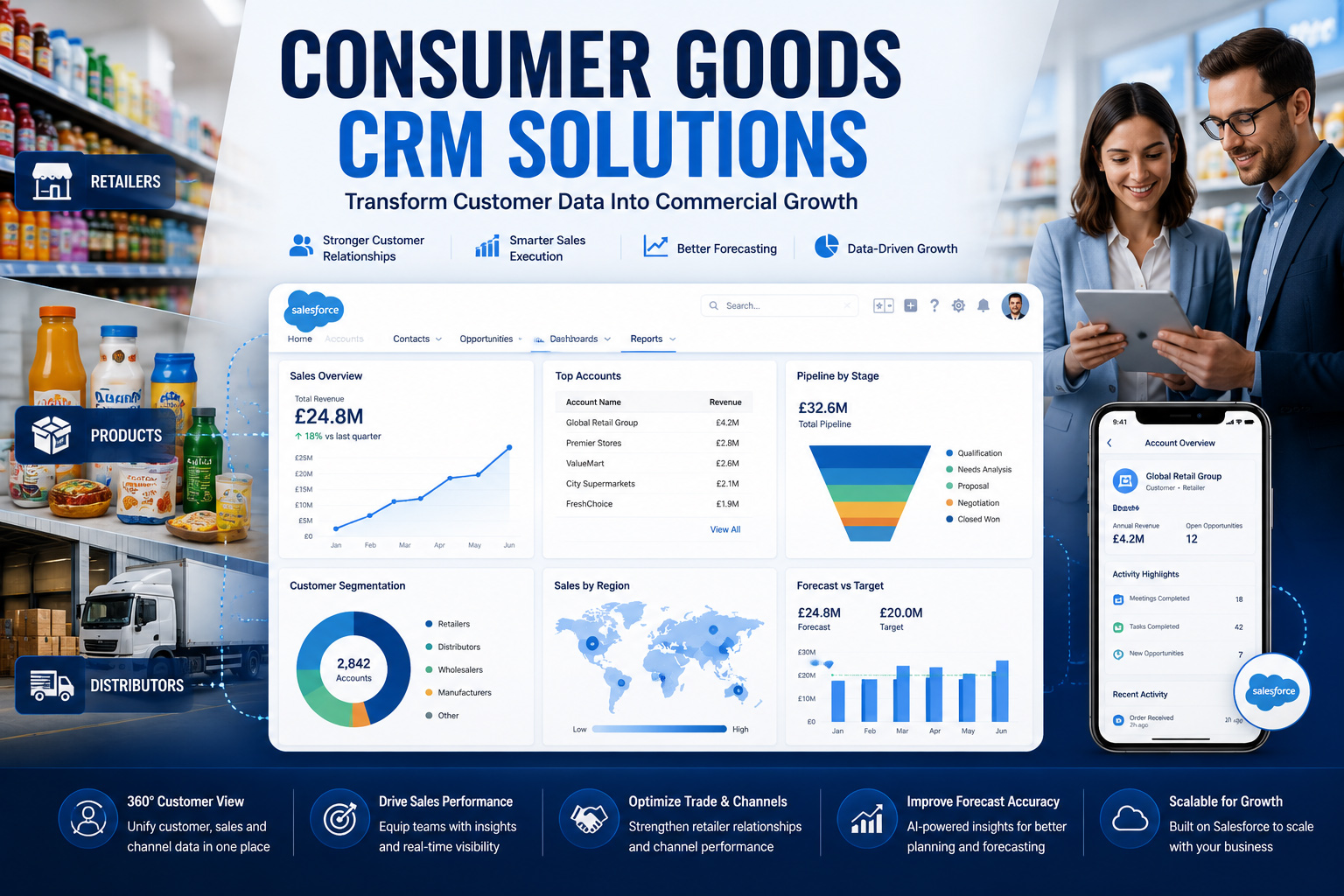
A Consumer Goods CRM helps CPG companies centralise customer information, manage sales activity, improve forecasting and create stronger relationships across every channel.
In this guide, we explain what a Consumer Goods CRM is, why it matters and how Salesforce can support consumer goods and CPG businesses.
What Is a Consumer Goods CRM?
A Consumer Goods CRM is a customer relationship management platform designed to help consumer goods and CPG companies manage customer relationships, sales processes, account activity and commercial performance.
Unlike a basic contact database, a Consumer Goods CRM can support complex B2B and B2C relationships across multiple channels.
It can help teams manage:
- Retailers
- Distributors
- Wholesalers
- Key accounts
- Field sales activity
- Customer service requests
- Sales opportunities
- Reports and dashboards
Why CPG Companies Need CRM Software
Consumer packaged goods companies often operate across multiple teams, markets and systems. Sales data may sit in one platform, customer data in another and operational information somewhere else entirely.
This makes it difficult to understand what is happening across the business.
CRM software helps CPG companies bring customer and commercial data together into one connected platform.
Better customer visibility
Teams can see customer history, account activity, opportunities, service issues and communication records in one place.
Stronger account management
Account managers can better track relationships with retailers, distributors and high-value customers.
Improved sales forecasting
CRM gives sales leaders clearer visibility over pipeline, opportunities and expected revenue.
More efficient field sales teams
Field teams can access account information, update activity and manage follow-ups more efficiently.
Better reporting
Leadership teams can use CRM dashboards to monitor sales performance, customer trends and team activity.
Common Problems CRM Solves for Consumer Goods Businesses
A well-designed CRM system can help solve many of the operational problems that hold consumer goods businesses back.
- Customer information stored in spreadsheets
- Poor visibility across sales and account activity
- Manual reporting processes
- Disconnected sales, finance and operations systems
- Inconsistent customer follow-up
- Difficulty tracking distributor or retailer performance
- Limited visibility of pipeline and forecasting
- Low accountability across sales teams
CRM gives teams a clearer structure for managing relationships, processes and performance.
How Salesforce Supports Consumer Goods CRM
Salesforce is one of the most flexible CRM platforms for consumer goods companies because it can be configured around specific business processes.
For CPG companies, Salesforce can support:
- Account and contact management
- Opportunity tracking
- Retailer and distributor management
- Customer service workflows
- Field sales activity
- Sales forecasting
- Commercial dashboards
- Marketing and campaign visibility
- Integration with ERP and ecommerce platforms
With the right configuration, Salesforce can become a central operating platform for sales, service and customer management.
Signs Your CPG Business Needs a CRM Upgrade
Your business may need a CRM upgrade if:
- Your teams rely heavily on spreadsheets
- Customer data is incomplete or duplicated
- Sales reporting takes too long
- Account managers lack visibility of customer history
- Leadership teams do not trust the numbers
- Field sales teams struggle to update activity
- Your CRM does not integrate with other key systems
- Your business is growing but your systems are not scaling
What to Consider Before Implementing a Consumer Goods CRM
Before implementing CRM, consumer goods companies should consider the following areas.
Business goals
Define what the CRM must improve, such as reporting, account management, sales visibility or customer service.
Data structure
Review how customer, retailer, distributor and product data should be organised.
User adoption
CRM only works when teams use it properly. Training and practical workflows are essential.
Integrations
Consider which systems need to connect with CRM, such as ERP, ecommerce, finance, marketing and customer service platforms.
Reporting requirements
Identify the dashboards and KPIs that leadership and sales teams need from day one.
Why Work With TTC Group?
TTC Group helps consumer goods and CPG businesses design, implement and optimise Salesforce CRM solutions.
Our consultants can support:
- CRM strategy and assessment
- Salesforce implementation
- Salesforce customisation
- CRM data integration
- Reporting and dashboard development
- User training and adoption
- Post-implementation optimisation
We help businesses move from fragmented systems to connected CRM platforms that improve visibility, efficiency and growth.
Frequently Asked Questions
1. What does Consumer Goods CRM mean?-
2. Is Salesforce good for consumer goods companies?+
3. What are the benefits of CRM for CPG companies?+
4. When should a CPG company invest in CRM?+
5. Can CRM integrate with ERP and ecommerce systems?+
Need a Better CRM for Your Consumer Goods Business?
If your consumer goods or CPG business needs better customer visibility, stronger reporting and a more connected CRM platform, TTC Group can help.
Learn more about our Consumer Goods CRM Solutions or speak to TTC Group about your Salesforce CRM roadmap.
Speak to a Salesforce Consultant