



Salesforce provides powerful out-of-the-box CRM functionality, but every business has different processes, reporting needs and operational challenges.
The key question is not whether Salesforce should be customised, but how much customisation your organisation actually needs.
Some businesses can achieve strong results with standard Salesforce configuration. Others need custom Salesforce development to support complex workflows, integrations, user experiences or industry-specific requirements.
In this guide, we compare out-of-the-box Salesforce with custom Salesforce development and explain how to decide which approach is right for your business.
What Is Out-of-the-Box Salesforce?
Out-of-the-box Salesforce refers to the standard functionality available within Salesforce without custom code or advanced development.
This may include:
- Standard objects such as leads, accounts, contacts and opportunities
- Basic page layouts
- Standard reports and dashboards
- Built-in workflow and automation tools
- Standard user permissions
- Core sales and service processes
For many organisations, standard Salesforce functionality is a strong starting point, especially during early implementation.
What Is Custom Salesforce Development?
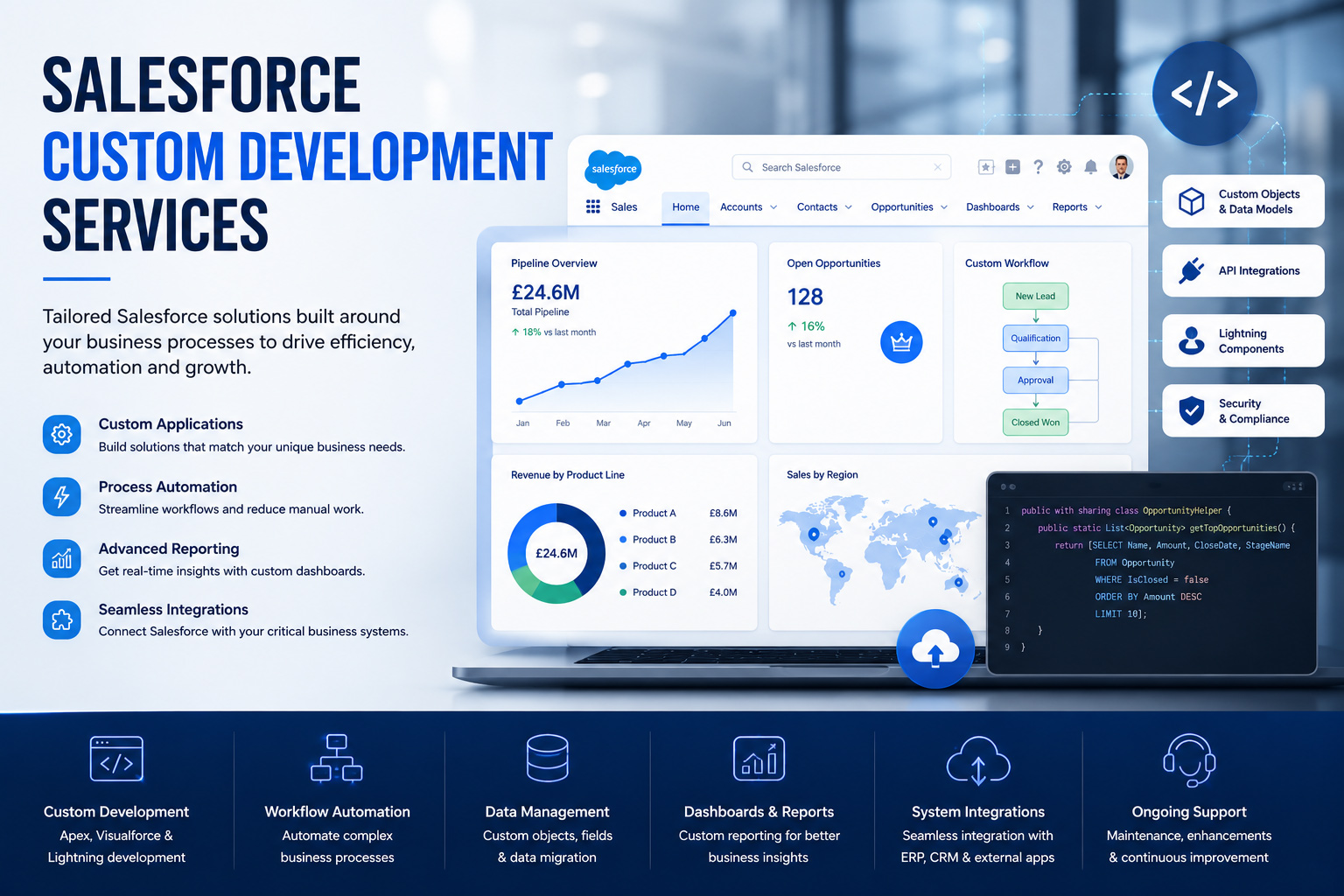
Custom Salesforce development involves building tailored functionality that goes beyond standard configuration.
This may include custom applications, objects, fields, workflows, integrations, Lightning components, Apex development and advanced dashboards.
Custom development is usually required when standard Salesforce functionality cannot fully support a business process or user requirement.
Out-of-the-Box Salesforce: Advantages
Faster implementation
Standard Salesforce functionality can usually be deployed faster than custom-built solutions.
Lower initial cost
Using existing Salesforce features can reduce upfront development time and cost.
Simpler maintenance
Standard configuration is often easier to maintain and update over time.
Best-practice structure
Salesforce includes proven CRM structures that work well for many sales, service and marketing teams.
Out-of-the-Box Salesforce: Limitations
While standard Salesforce functionality is powerful, it may not be enough for every business.
Limitations can include:
- Processes that do not match how your teams actually work
- Limited flexibility for complex workflows
- Dashboards that do not answer key business questions
- Manual workarounds outside Salesforce
- Difficulty integrating with other business systems
- Low user adoption because the system feels generic
Custom Salesforce Development: Advantages
Tailored business processes
Custom development allows Salesforce to reflect the way your organisation actually operates.
Improved efficiency
Custom automation can reduce manual tasks, duplicate entry and process delays.
Better reporting
Custom dashboards and data models can provide clearer visibility of performance, risk and growth.
Stronger integrations
Salesforce can be connected with ERP, finance, ecommerce, recruitment, marketing and customer service platforms.
Better user adoption
When Salesforce is easier to use and more relevant to daily work, teams are more likely to use it properly.
Custom Salesforce Development: Risks to Avoid
Custom development can deliver significant value, but only when it is planned correctly.
Common risks include:
- Over-customising simple processes
- Building functionality without clear business requirements
- Creating unnecessary technical debt
- Making future Salesforce upgrades more difficult
- Developing features that users do not adopt
- Failing to document custom functionality properly
The best Salesforce development approach balances flexibility with simplicity.
When Should You Use Out-of-the-Box Salesforce?
Out-of-the-box Salesforce may be the right choice when:
- Your sales or service process is relatively straightforward
- You need a fast implementation
- Your budget is limited
- You are launching Salesforce for the first time
- Your team can adapt to standard CRM workflows
- You want to avoid unnecessary complexity
In many cases, businesses should start with standard functionality and customise only where there is a clear commercial reason.
When Should You Choose Custom Salesforce Development?
Custom Salesforce development may be the better choice when:
- Your business has complex or unique workflows
- Your teams are using spreadsheets or manual workarounds
- You need Salesforce to connect with other systems
- Reporting requirements are more advanced
- User adoption is low because Salesforce is difficult to use
- You need industry-specific CRM functionality
- Your existing Salesforce setup no longer supports business growth
Which Approach Is Better?
There is no single answer. The best approach depends on your business goals, process complexity, budget, timeline and long-term CRM strategy.
For most organisations, the right answer is a blended approach:
- Use standard Salesforce functionality where it works well
- Configure Salesforce to support your core processes
- Develop custom functionality only where it creates clear value
- Keep the platform scalable and easy to maintain
This avoids unnecessary complexity while ensuring Salesforce supports the way your business actually works.
How TTC Group Can Help
TTC Group helps organisations assess, configure and develop Salesforce solutions that support commercial growth and operational efficiency.
Our Salesforce consultants can help with:
- Salesforce discovery and requirements gathering
- CRM process mapping
- Salesforce configuration
- Custom Salesforce development
- Workflow automation
- Salesforce integrations
- Dashboards and reporting
- User adoption and training
If your current Salesforce platform feels too generic, too manual or too disconnected from your business processes, custom development may help you get more value from your CRM.
Frequently Asked Questions
1. What is out-of-the-box Salesforce?–
2. What is custom Salesforce development?+
3. Is custom Salesforce development always necessary?+
4. Can custom Salesforce development improve user adoption?+
5. Should Salesforce be customised before or after implementation?+
Need a Salesforce Solution Built Around Your Business?
TTC Group can help you decide where standard Salesforce configuration is enough and where custom development will create measurable value.
Learn more about our Salesforce Custom Development Services or speak to TTC Group about your CRM requirements.
Speak to a Salesforce Consultant